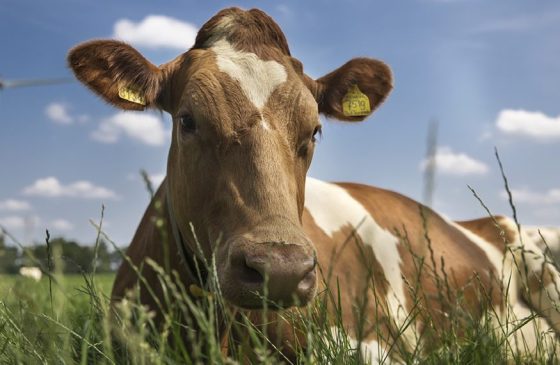
We are a dairy company and part of a dairy cooperative of around 15,000 member dairy farmers. Our member dairy farmers supply the milk usen in many of the products we make. Healthy cows are important for dairy farming and for producing dairy products that provide nutrition to millions of people. Our member dairy farmers care for their cows every day and work to provide appropriate housing, feed, water and health care. Technology supports dairy farmers to take good care. Curious?
Animal welfare worldwide
Healthy and well-cared-for cows can live longer and may require less medical treatment. Supporting animal health and welfare is also important for efficient dairy farming. Our member dairy farmers work every day to care for their cows and support their health and welfare.
We have 150 years of experience in the world of dairy farming. We have used this experience to develop programmes and approaches that support animal health and welfare in our dairy supply chain. This means we do not only apply this in the countries where our member farmers operate. Through our Dairy Development Activities we share knowledge and practical experience related to animal health and welfare with dairy farmers in Asia, Africa and Eastern Europe.
We only use animal products other than milk for a few products within our complete portfolio, for which we also have animal welfare requirements. Read more on this page.
Improving animal welfare
KoeMonitor: safeguarding animal health
We continuously invest, share experiences and learn to improve animal welfare across the dairy sector. KoeMonitor helps with that. This includes various components, such as KoeKompas and KoeData, which give our member dairy farmers and certified veterinarians even more insight into the welfare of the cows. Many indicators are used for this. This leads to quarterly reports for each individual dairy farm. Our animal welfare policy ensures that certified veterinarians visit all our member dairy farmers at least once a year to promote animal welfare and health from a preventative perspective. The veterinarian identifies the potential risks for the health and welfare of the cows. The KoeKompas shows what is going well and what could be improved in terms of milking, feed and water, housing, animal welfare, work routines, animal diseases and young stock rearing. The veterinarian advises dairy farmers on how to further improve the health and welfare of their cows.
Foqus planet: our own requirements for animal welfare
Foqus planet is FrieslandCampina’s quality and sustainability programme for member dairy farmers. The programme includes baseline requirements for milk quality, food safety, animal health and animal welfare that all member dairy farmers must meet. These requirements go beyond legal standards and include measures such as mandatory animal health checks and Animal Health Plans.
In addition, Foqus planet encourages continuous improvement through its Sustainable Development component. Dairy farmers are rewarded for their performance on selected sustainability indicators, including animal health and welfare. The programme includes indicators related to areas such as longevity, calf rearing and living conditions. By combining baseline requirements with performance-based incentives, Foqus planet encourages continuous improvement in animal health and welfare on member dairy farms.
Dairy development: knowledge about animal welfare in other countries
Through Dairy Development, we offer training courses to dairy farms in Asia, Africa and Eastern Europe. For example, experts selected by us provide a CowSignals training course in which farmers learn about animal health & animal welfare, housing, feed and water management and business economics. The training courses help participating farmers strengthen their knowledge of animal health, animal welfare and farm management practices.
Covenant to increase animal welfare in livestock farming
Through ZuivelNL and the Dutch Dairy Association (NZO) we signed a covenant on dignified livestock farming. In this covenant, livestock sectors, the government, market and chain parties, and animal welfare organisations join forces to work towards increased animal welfare in livestock farming by 2040. For the dairy sector, the central action plan is the roadmap by ZuivelNL and the Dutch Association for Animal Protection (Dierenbescherming). This roadmap outlines ambitions such as promoting meadow grazing and further developing barn housing systems. In this way, we contribute to ongoing efforts to further strengthen animal welfare within the dairy sector.
Animal health and animal welfare on the farm
Our farmer Niek Heijink about animal welfare on his farm

Checklist for healthy calves
Supporting animal health and welfare is important for dairy farmers and their livestock. Despite all the care and attention, some calves may still die if they are not strong enough. All of our member dairy farmers keep track of the number of calf mortalities on their farm. If this number is too high, the dairy farmer is required to sit down with the vet and draw up a plan of action to reduce it. A checklist for healthy calves is also available. This checklist and the plan of action were created in cooperation with the Royal Dutch Society for Veterinary Medicine (KNMvD) to ensure that farmers take the appropriate measures.
Frequently asked questions about animal welfare
About the welfare of our cows
