Learn more about cows
What do cows eat?
Cows mainly eat roughage, such as grass and corn, which makes up about 92% of their diet. The remaining 8% is feed concentrate – pellets that contain ingredients such as wheat, citrus and rapeseed and are enriched with minerals and vitamins. The exact composition depends on what the cow needs. In addition, cows drink about 100 litres of water a day. Read more about what cows eat in this fact sheet published by the Dutch Dairy Association (NZO).
Which breeds of cattle are used to produce milk?
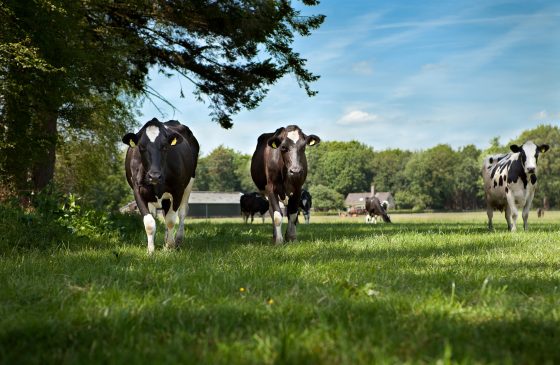
In the Netherlands, the majority of dairy farms have Holstein Frisian cows. These are black or reddish brown with white spots, and can produce a lot of milk. The Netherlands is home to other breeds as well, such as the MRIJ. Blaarkop cattle are common as well. These cows are known for their milk as well as their meat. There are also farms that raise brown Jersey cows, which produce milk with a higher fat content.
Is it true that calves are separated from their mothers?
Yes, that is true. Farmers do this to ensure the health of the calves. Newborn calves have very low natural resistance. Farmers are able to monitor, feed and provide proper hygiene for newborn calves more effectively when they are not with their mother. This allows the calves to grow up healthier. For example, newborn calves must receive sufficient mother's milk containing antibodies as quickly as possible. In addition, cows largely leave calves alone in nature, so they grow up with other calves in the herd.
Are the cows inseminated?
Yes, that has been common practice for most cows for decades. Of course, it is done in a responsible way. There are several reasons why cattle farmers opt for artificial insemination. For example, it reduces the risks of inbreeding and the transmission of infectious diseases when mating. A cow is inseminated only when she indicates that she is fertile.
Are cows living shorter lives?
The expectation is that the average dairy cow will live longer. Our member dairy farmers strive for healthy cows that have a good and long life. At the end of 2018, the average lifespan of a dairy cow was upwards of five and a half years. In 2021 the average lifespan increased with one hundred and eighty-four days. Meaning the cows of our member dairy farmers on average live six years and sixteen days. It is expected that, in line with the aim of dairy farming, cows will continue to age.
What happens when a cow leaves the dairy farm?
Not only on dairy farms do we find it a dairy cow’s welfare important, even when it is being transported. It must be transported in an animal-friendly manner with means of transport that guarantees animal welfare. In addition, stricter requirements apply to the transport of animals at extreme temperatures. This transport occurs, for example, when a dairy cow is sold to another farmer or because she is going to the slaughterhouse at the end of her life. The slaughter of animals must be done as carefully and as stress-free as possible with respect for the animal. Therefore, all animals must be stunned before slaughter. The above also happens in line with rules imposed by the Dutch government and our ISO 26000 statement.
Are the cows genetically modified?
The conditions for genetic modification have been laid down in European law for years and these also apply to our dairy farmers and their livestock.
Meadow grazing
Are cows healthier and happier if they go outside?
Farmers benefit from healthy and happy cows because such cows produce a lot of milk. However, it is difficult to determine scientifically whether that happiness is related to grazing outdoors. In any case, being able to choose whether they stay inside or go outside is best for cows. Wherever the cow is, the cow must always be treated well.
Why are not all cows outside?
It seems simple: the farmer opens the barn doors, and the cows can go outside if they want. But things are quite different in reality; there is a very complex process involved. For example, when cows go outside, the farmer no longer has a clear view of what the cows are eating and drinking. In addition, there must be enough grass in the meadow to ensure the cows continue to eat enough. That is why farmers must properly fence off sections of meadow and make sure the cows graze on the right piece of land each day. These are all reasons why cows are not always outside.
What if it is not possible to let cows graze enough?
Some of our member dairy farmers are unable to let their cows graze in the meadow because they do not have enough land. Or their land (or part of it) might be inaccessible to the cows. Partial outdoor grazing is a solution for some of those farmers. In that case, some – at least 25% - but not all of the cows go outside.