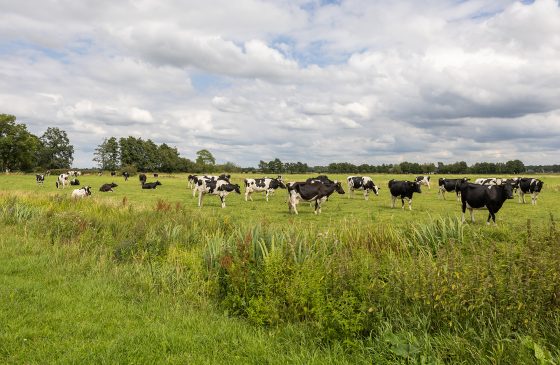
We face a major challenge: demand for nutritious and affordable food is growing, while climate change and biodiversity loss call for a different approach to the way we produce food. That is why we are working with our member dairy farmers on an approach to agriculture and food production: regenerative agriculture. At FrieslandCampina, we are exploring how regenerative agriculture can contribute to climate, biodiversity, soil and water-related objectives, based on measurable results.
What is regenerative agriculture?
Regenerative agriculture is a way of farming that focuses on soil life, water cycles, biodiversity and climate-related farming practices. This approach aims to support the long-term resilience of dairy farms and farming businesses. Within FrieslandCampina, regenerative agriculture is linked to several focus areas:

1. Reducing climate and environmental impact
By reducing greenhouse gas emissions, minimising nitrogen losses, and using resources efficiently.2. Supporting biodiversity and soil health
By promoting herb-rich grasslands and landscape features, building healthy soils, and supporting biodiversity-focused farming practices.3. Increasing the resilience of dairy farms
By supporting farmers in developing resilient and economically viable business models.
From vision to action
The international Regenerating Together Framework from the SAI Platform provides guidance, structure, and a common language for regenerative agriculture. The framework defines four impact areas: soil, biodiversity, water and climate, and outlines how companies and farmers can work towards measurable improvements.
FrieslandCampina collaborates with Arla, Danone, DSM-Firmenich, and Rabobank within the Future Fit Dairy Initiative (FFDI). Together, we are translating the SAI framework into practical applications for dairy farming in Northwest Europe. Based on this, FrieslandCampina has established indicators, thresholds, and target values, allowing us to measure, compare, and monitor farmers’ performance.
Since 2018, FrieslandCampina has been measuring the performance of all its member dairy farms on climate and biodiversity. Based on this data, we have developed an integrated score that provides insight into performance across selected nature and climate-related indicators.
Our study group approach
There is no standard approach to regenerative agriculture. Every farm is unique. That is why, through our study group approach, we work with nearly 60 member dairy farmers from the Netherlands, Belgium, and Germany. Together, we investigate the impact of regenerative agricultural practices on soil health, biodiversity, and climate. In addition, our members critically assess the practical and financial feasibility on their own farms. Participating dairy farmers follow a three-phase programme:
- Explore (introduction, training, baseline measurement)
- Improve (experimenting with measures, collecting data)
- Transform (implementation, support in overcoming obstacles)
We support our member dairy farmers with knowledge, data and guidance, and we learn alongside them. The study group is part of the broader ReGeNL programme, which is co-financed by the National Growth Fund. We recognise that regenerative farming can only succeed if it is also economically viable. That is why, together with our partners, we are developing an open standard for regenerative agriculture: transparent, measurable, and practical.
In addition to the study group, we learn from four dairy farms that demonstrate strong performance across multiple regenerative agriculture indicators, each with a completely different approach: organic, nature-inclusive, circular, or efficiency-focused. Although their approaches differ, these model farms all perform strongly across a range of regenerative agriculture indicators. However, not all farmers follow the classic principles of regenerative agriculture, such as grazing, extensification or organic farming.
How is that possible? How do these dairy farmers achieve strong performance across similar indicators while taking such different approaches? And what does that tell us about our measurement methods? We explore these questions together.

Towards a scalable approach
By linking regenerative agriculture to measurable, scientifically grounded goals, we aim to increase our understanding of how regenerative agriculture can contribute to addressing climate and biodiversity-related challenges. We do not do this alone, but together with our members, customers, partners and society.
