The world population is expected to grow to 10 billion people in 2050. This will unmistakably lead to an increased need for high quality, nutritious and affordable food. Currently, access to sufficient and healthy food is not self-evident for millions of people worldwide.
Low- and middle-income countries (LMICs) and upper-middle-income countries (UMICs) bear a disproportionate burden of malnutrition, often facing multiple forms simultaneously, including undernutrition, overweight and obesity, and micronutrient deficiencies. Poor dietary quality is a major contributor to this challenge, with many diets lacking the nutrient density required to support optimal health.
In many countries, the Cost of a Healthy Diet (CoHD) remains unaffordable for large segments of the population, forcing households to rely on cheaper, less nutritious options. Improving access to nutrient-rich foods is therefore critical to supporting food security, improved nutrition, and the ambitions of Sustainable Development Goal 2 - Zero Hunger.
The role of dairy in the combat of malnutrition
As an international food producing company, our dairy products are consumed in over 100 countries around the world. Guided by our purpose nourishing by nature, we produce dairy products with valuable nutrients from milk, contributing to food security for millions of people worldwide.
Malnutrition, in all its forms and combinations (undernutrition, micronutrient deficiencies, and obesity), is a serious problem in both lower and higher income countries. Dairy products are nutrient-dense and contain valuable nutrients that can contribute to a healthy diet. Milk naturally contains proteins, calcium, and many important vitamins and minerals. In cases where certain populations experience deficiency of specific nutrients, dairy products can be fortified with additional vitamins and minerals.
Understanding local contexts and needs
The affordability and accessibility of nutritious foods are influenced by a wide range of local factors, including geographic characteristics, socio-economic conditions, and food retail systems. As these conditions vary significantly between markets, effective nutrition solutions must be tailored to local consumer needs and contexts. Understanding these factors specific to the market is essential for developing products and interventions that are both nutritionally relevant, affordable and accessible to populations who need them most.
How we provide access to affordable nutrition
Access to nutritious food is essential for health, growth and well-being. Yet millions of people around the world still lack access to the nutrients they need to live healthy lives. Guided by our purpose nourishing by nature, FrieslandCampina is committed to helping close this gap by making high-quality, nutritious dairy products more accessible and affordable.
Broadening access to nutrition programme
FrieslandCampina's affordable nutrition journey was accelerated through the Broadening access to nutrition (BATN) programme, launched in 2020 to increase the availability and affordability of nutritious dairy products for populations at higher risk of malnutrition, particularly lower-income households. The programme focused on developing affordable, nutrient-rich products tailored to local needs and delivered through accessible pack sizes, price points, and distribution channels. Over its five-year duration, BATN exceeded its target, reaching 19% of consumer sales volumes in 2025 and creating the foundation for FrieslandCampina's long-term affordable nutrition ambitions, which today, is integrated into the Global Nutrition Framework.
FrieslandCampina Global Nutrition Framework

FrieslandCampina's ambition is to deliver healthy and sustainable nutrition for all through its 2030 Global Nutrition Framework. The framework is built around two strategic pillars: Goodness of Dairy, focused on supporting health and nutrition through nutritious dairy products across life stages, and Access to Nutrition, focused on ensuring that dairy-based nutrition is within reach of those who need it most.
Accessible and affordable nutrition
Our ambition is to increase the share of affordable nutritional products for lower-income population groups in selected markets to at least 30 percent of total sales volume by 2030.
Results
2024: 14%
2025: 19%
Target population
FrieslandCampina's affordable nutrition efforts are aimed at consumers who experience difficulty purchasing and maintaining a healthy diet due to financial constraints, particularly in Nigeria, Ghana, Côte d'Ivoire, Pakistan, Malaysia, Thailand, Indonesia, Vietnam, and the Philippines. This target population includes individuals and households whose incomes are insufficient to consistently afford the cost of a healthy diet, while still having enough purchasing power to access food products available through the formal market.
The characteristics and circumstances of the target population differ across markets. While all target consumers face challenges in accessing a healthy diet, the underlying drivers of affordability vary by country. Factors such as income, dietary habits, household spending patterns, geographic location, and food retail systems influence a consumer’s ability to obtain and maintain a healthy diet. As a result, the target population is not a homogenous group but encompasses a diverse range of consumers who experience nutrition affordability challenges in different ways and to varying degrees across markets.
Furthermore, not all vulnerable consumers can be reached effectively through commercial channels alone. Partnerships and community-based programmes therefore complement FrieslandCampina's commercial reach to extend nutrition support to groups facing additional affordability barriers.
Using Local Insights to Shape Affordable Nutrition Initiatives
FrieslandCampina uses local nutrition research to identify important nutrition needs and health challenges in different markets. In Southeast Asia, the Southeast Asian Nutrition Surveys (SEANUTS I & II) was conducted to evaluate the nutritional status, dietary habits, physical activity, and growth of infants and young children aged 6 months to 12 years old, across Indonesia, Malaysia, Thailand, and Vietnam. This study generated country-specific insights that helped inform product development and fortification to address identified nutrient gaps.
Similarly, the AfricaNutrition programme examined dietary patterns and nutrient intake among vulnerable women and children in Côte d'Ivoire, providing insights that supported the development of affordable nutrition products tailored to local needs. These research programmes have helped to ensure that FrieslandCampina's affordable nutrition products are both scientifically grounded and relevant to the communities they serve.

SEANUTS II: a large nutritional survey among children in 4 countries in Southeast Asia
South East Asian Nutrition StudyWe are developing products that are affordable and have an optimal nutritional value
Arie Punt's storyHealthy nutrition is about balance, moderation, and variety
Interview with Professor Bee Koon Poh
Affordable Nutrition Strategy
Under the Access to Nutrition pillar, FrieslandCampina aims to improve food and nutrition security by increasing access to nutritious dairy products for consumers with limited purchasing power. The strategy combines product formulation, affordable pricing, smaller unit pack-sizes, and increased distribution to make nutritious products more accessible.
Products are designed and reformulated to address local nutritional needs, including fortification with essential vitamins and minerals where relevant. Affordable price points are achieved through efficient product formulation that maintains our nutrition standards, as well as with a range of pack sizes that either offer better value per serving or provide a lower upfront cost, depending on consumer needs. Accessibility is strengthened through distribution strategies, particularly in general trade, that increase product availability across both urban and rural communities, including areas that are underserved by modern retail channels.
Some examples

Peak in Nigeria
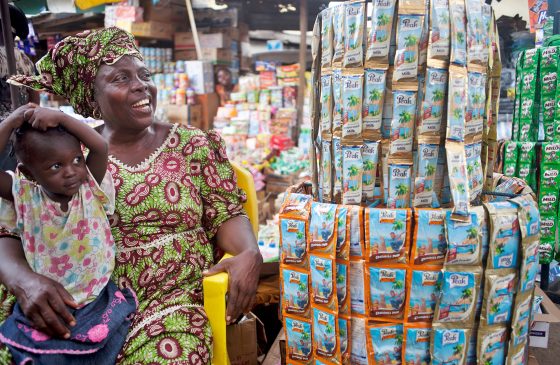
Peak Instant Full Cream Milk Powder is a fortified milk powder formulated to provide affordable and accessible nutrition to Nigerian consumers, particularly in households with limited purchasing power and limited access to refrigeration. Enriched with essential vitamins A, B1, B6, C, and D3, it provides nutritional benefits while offering convenience in storage and preparation. Available in an affordable 14g sachet, Peak Instant Full Cream Milk Powder enables more consumers to enjoy the goodness of full cream milk at an accessible price point, supporting everyday nourishment across households.
Olper's in Pakistan
Olper’s Full Cream Milk is a UHT milk designed to provide safe, nutritious dairy to Pakistani households. In a market where loose milk dominates consumption and packaged milk is often perceived as less affordable, Olper’s focuses on increasing accessibility through packaging innovation and a wide range of pack sizes. The 250 mL pouch format provides a low-cost entry point that enables lower-income consumers to purchase safe, nutritious milk in quantities that fit their daily budgets.
Frisian Flag in Indonesia
Frisian Flag Nutribrain Omega is a fortified ready-to-drink milk developed to provide affordable nutrition for Indonesian children. It was reformulated in response to nutritional challenges identified through the SEANUTS II Indonesia study. Designed to help address common nutrient deficiencies among children, the product contains omega-3 and omega-6 fatty acids together with nine vitamins and four minerals that support healthy growth and development. To further improve affordability and accessibility, Nutribrain Omega is available in a smaller 110 mL pack, providing a lower-cost option that allows more children and families to access fortified dairy.
Foremost in Thailand
Foremost Omega 369 is a fortified UHT milk designed to provide essential nutrition at a price point accessible to mainstream households. Developed in response to local nutritional needs identified through findings from the SEANUT II Thailand study, the product contains 23 essential nutrients that support child growth, cognitive development, and help address common nutrient gaps among Thai children.
Dutch Lady in Vietnam
Dutch Lady Cao Khỏe (“High and Healthy”) Milk is designed to provide essential nutrition that is relevant to the needs of Vietnamese children. Following the findings of the SEANUTS II Vietnam study, Dutch Lady reformulated its ready-to-drink milk portfolio to address key nutrient deficiencies identified among children. The products are fortified with essential vitamins and minerals, including vitamin C and vitamin D, helping to improve nutrient adequacy and support healthy growth and development. To further improve affordability, Dutch Lady offers products in a variety of pack sizes and formats, including the 220 mL Fino pouch, which is a more affordable option to the standard brick packaging.
Alaska in the Philippines
Alaska’s fortified Powdered Milk is designed to provide accessible nutrition for Filipino families across socio-economic groups. The product delivers key nutrients such as calcium, vitamin D, and other essential vitamins and minerals. By combining micronutrient fortification with a shelf-stable powdered format, Alaska provides a practical and nutritious dairy option that is well suited to the needs of families in the Philippines. To further enhance affordability among households with limited purchasing power, the Powdered Milk is available in a 33g sachet in addition to 7 other pack sizes.
Monitoring affordability and accessibility
To help assess affordable nutrition products and improve reach, FrieslandCampina continuously monitors product accessibility and affordability through distribution, penetration, and consumer purchasing data. Continuous monitoring helps assess whether products are available across different regions and income groups, and inform decisions on pricing, pack-size innovations, and distribution strategies to ensure access to nutritious foods continues to improve.
Other Programmes to support healthier futures
In addition to our commercial approach, food aid remains necessary. FrieslandCampina collaborates with the Red Cross, provides products to Food Banks, supports School Milk and School Feeding programmes, and is engaged in community projects. To address malnutrition effectively, it is crucial to ensure the availability of high-quality milk. To increase the availability of high-quality milk in certain countries, FrieslandCampina has initiated Dairy Development activities.
School milk programmes
FrieslandCampina works with local schools, governments, and community organizations to improve access to nutritious dairy products for children. Through school milk programmes, the company supports healthy eating habits and nutrition awareness while supporting children’s access to nutritious food and encouraging balanced diets and active lifestyles. Examples include Thailand's One Million Smiles Project, Indonesia's Gerakan Nusantara (GERNUS), and Pakistan's School Milk Programme. These initiatives are designed to reach children in settings where nutrition interventions can have a lasting impact, complementing the affordable nutrition strategy.
Nutrition education initiatives
FrieslandCampina also invests in nutrition education to help consumers make informed dietary choices. These programmes are tailored to local contexts and often focus on improving understanding of healthy diets and the nutritional value of dairy. For example, in Nigeria, the "Show Peak Love" campaign on World Milk Day helped to raise awareness about the nutritional differences of full cream milk compared to variants such as fat-filled milk, dairy creamers, and non-dairy alternatives, helping consumers make more informed nutrition decisions.
Responsible marketing
Aside from nutrition initiatives and programmes, FrieslandCampina is committed to responsible marketing practices that support healthy diets and informed consumer choice. The company follows internal and external guidelines including the FrieslandCampina Corporate Standard for Responsible Marketing Communications and the EU Pledge, to ensure that all brand and product communications are clear, accurate, and transparent. Particular attention is given to the responsible marketing of products intended for children, ensuring that commercial activities align with public health objectives and support positive nutrition outcomes.

