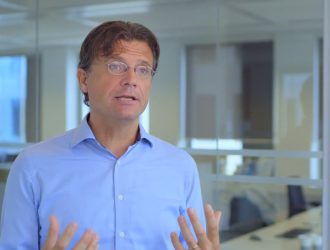
We cannot deny it. Packaging is crucial for keeping our dairy products both fresh and safe, all over the world. There is no doubt about the usefulness, but there is doubt about the materials and the processing of these. Customer expectations and regulations play important parts as well. The pressure on nature is increasing. How do we respond to this and which challenges will we be faced with? We talk about this with Patrick van Baal, Global Director Packaging Development at FrieslandCampina.
“I am often asked: how do we decrease the environmental impact of our packaging, reduce the CO₂ emission and make sure that less CO₂ ends up in nature? Just as with the issues our member dairy farmers have to cope with, the solution is not to be found or implemented right away. Besides, we also do things the FrieslandCampina way, so in a multidimensional, thorough, measurable and ambitious manner. This is not the easiest way, but we think it is the best. We want all our packaging to be circular in the year 2050. We are working towards this goal in steps. This means that we firstly want all our packaging to be recyclable and/or reusable in the year 2025. Apart from this, we do no longer want to make use of any fossil sources when producing packaging. Energy and materials may only come from renewable sources, such as trees or sugar cane.”
“If we want to our packaging to be circular in the future, we are dependent on the entire chain. We can make recyclable packaging, but the packaging must then also be sorted, collected and recycled in the right way. It's an integral approach. It all starts with the consumer and the collection of empty packaging. Additionally, we have to make sure that our packaging materials are compatible with the correct sorting and recycling technologies. Our cooperative approach is in line with these problems. It is in our DNA to really make an impact by means of long-term partnerships with relevant parties. The circular chain does not have a beginning or an end, so the question is who should take the lead in reaching this objective. We take our responsibilities by interlinking the parts of the chain and by taking new initiatives together with the various partners within the chain.”
It is in our DNA to really make an impact by means of long-term partnerships with relevant parties.
“We try to make all parties involved aware of the problems and of the roles they play in this. And we are goal-oriented. Our packaging will probably never be made of reused material for 100 percent and this actually is not a problem. Our objective is to bring down our impact on the environment to zero. Circularity is one of the means to achieve this, because no new materials need to be made and the materials that are reused do not end up in nature. Eventually, the point is that we will no longer make use of fossil fuels and as a result of this reduce the CO₂ emission. And that we make sure that empty packaging will no longer end up in the environment. So apart from making our packaging circular, we are also very active in applying renewable materials and in reducing our use of energy and, consequently, our CO₂ footprint.”
“Many projects cover long periods of time and therefore we are taking a lot of initiatives simultaneously. I expect that after the introduction of improvements, such as our 100% renewable milk cartons, the paper straws and the recyclable cheese packaging, we will be able to launch a large number of new improvements in the coming years.”