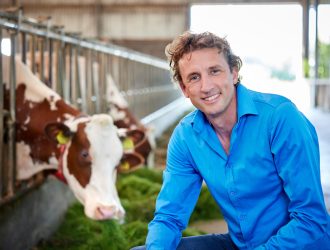
On March 31 2025, Coöperatie Rundvee Verbetering (CRV), Wageningen University & Research (WUR), and FrieslandCampina jointly presented the results of an innovative research program that helps dairy farmers reduce their climate impact. This program focuses on breeding cows that naturally emit less methane while maintaining their health and productivity.
The research shows that there are significant differences in methane emissions between cows, with variations of up to 40 grams of methane per day – about 10% of the total emissions per cow. By smart breeding and selecting the right bulls and cows, farmers can reduce methane emissions and increase milk production without adverse effects on the cows' health and lifespan.
Joint Research
CRV, Wageningen University & Research, and FrieslandCampina started joint research in 2020 to reduce methane emissions from cattle. The Ministry of Agriculture, Nature and Food Quality supports this project, 'Climate Smart Cattle Breeding,' financially. On 89 practical farms, so-called 'sniffers' measured the methane emissions of cows in the milking robot. Over four years, this involved a total of 14,000 cows. These data are the basis for the methane breeding value that CRV introduces in the index run of April 2. The research results show that by 2050, a reduction of up to 40% is possible compared to 2018.
Further Reducing the Climate Impact of Milk Production
Jeroen Heck, senior research specialist at FrieslandCampina and involved in the research, says: "This research shows that breeding can make an important and structural contribution to reducing methane emissions. We will not prescribe to member dairy farmers what they should do with this, but it is good that there is an additional way to reduce methane emissions. We encourage CO2 reduction through FoqusPlanet, but farmers themselves have the choice of whether and how to do this."