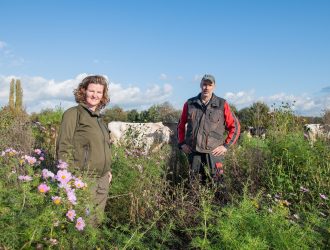
“We have quite a difference of opinion and partly a different interest”, say member dairy farmer Pieter Brouwer and forester Esther Rust during a walk on Pieter's land. But they agree that together they make the landscape. “It is therefore very logical to work together. The crux is better communicating together.”
The contact between Pieter and Esther arose thanks to about three hectares of extensive herbaceous grassland that Pieter, who supplies On the way to PlanetProof milk, leases from Natuurmonumenten (the largest private organisation for nature conservation in the Netherlands). “We mow it three times a year and turn it into hay,” Pieter says. He regularly consults with Esther, who, as coordinator of nature management at Natuurmonumenten, is responsible for the management of about 1,000 hectares in the IJsselvallei. “The goal is impoverishment, but then you keep an eye on how long the crop can still be used as feed for the cows,” says Esther.
Research into soil life
Pieter and Esther are now also working together in a project that maps the soil life of natural grassland and agricultural grassland. “I was triggered by a professor saying that Dutch agricultural land would be 'dead',” says Pieter, who found a supporter in Esther. “Everything starts in the soil, including nature conservation.” Together they set up the project and sought additional researchers and funding. About ten dairy farms and twenty natural grasslands have now been investigated for the amount of springtails and mites in the soil. It is a good example of collaboration between nature organisations and dairy farmers. “Everyone is on the edge of the seat for what the outcomes are,” says Pieter. “You are all looking for the answer to the question of what is happening in the soil now and how you can respond to that in management.”
Grumbling does not help
Pieter and Esther know that there is also mistrust about the weather between farmers and foresters. And that they do not always agree with each other, but they don't have to say that either. “You feel the resistance, but it doesn't help to keep grumbling,” says Pieter, who is also a director at his regional LTO (Dutch Agricultural and Horticultural Association). “Keep talking and discuss what you can do about it. A good conversation is the best way to bridge differences.” Esther adds: “Ultimately, we create the landscape together, so it makes perfect sense to work together.”

Revenue model for nature
Hedges, canals, shrubland and herbaceous edges; both nature organisations and dairy farmers have to deal with it. “Proper maintenance costs money,” says Pieter. “Society asks for more nature, and then you also have to talk about compensation. In recent years, nature organisations have also recognised that more compensation is needed for more farmland. It is difficult for nature managers to estimate the costs for the farmer.” On the other hand, the nature organisations have a lot of knowledge and experience about the management of landscape elements, says Esther. “It seems as if they are two very different worlds, but it is both about land and soil and we can still learn a lot together there.”
Stroll around
Esther indicates that friction can arise from not speaking. “When land is designated for nature development, for example, while it is also good agricultural land.” Pieter nods. “For us as farmers this is sometimes hard to understand. But even then I think you should be proactive in the conversation. Then you can still disagree, but you will get better insight. There may also be some possibilities in consultation. Express your interest. Perhaps it is still possible to exchange in collaboration. You achieve more with a critically positive attitude and keeping an eye on each other's interests.” Finally: take a walk with your forester through the area, drink a cup of coffee together, they advise the other FrieslandCampina farmers. “Then you hear from each other what is going on and what is going on. That provides understanding for both sides and then you will notice that you may have more similarities than differences.”