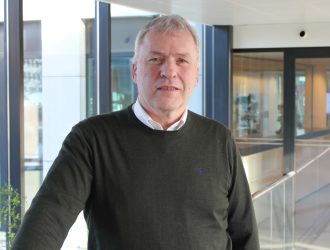
Reduce, renew, reuse, replace. Klaas Vos often uses these words. As Global Sustainability Manager Supply Chain he works together with a lot of colleagues on achieving our sustainability ambitions. He is involved in projects aimed at, for instance, making the production locations and milk transport more sustainable. It is our objective to make processes where possible, such as for packaging, water and energy, circular in the long term. This really is not an easy thing to do.
"But it is a crucial thing to do when looking at the global requirements and expectations of companies to really operate in balance with nature and the living environment in the long term. We want to become CO2-neutral, so no longer emit any unnecessary greenhouse gases. Apart from this, we want to become circular where possible, making sure that this will enable us to keep using the sources forever. Therefore we are working on reducing the use of energy at the production locations, we try to find ways to reuse energy and our aim is to stop using fossil energy sources and only make use of renewable energy sources. This is not easy, because our locations have to keep running and for this need a stable energy network. Processing and producing dairy just involves using energy. We cannot change this. However, in order not to waste this energy, we are working hard on raising our efficiency, setting up energy-saving processes and making use of residual flows, which are still very often regarded as waste."
We want to become CO2-neutral, so no longer emit any unnecessary greenhouse gases. Apart from this, we want to become circular where possible.
“Thanks to the fact that a lot of our members generate energy through sun and wind, there is enough clean electricity to provide our production locations in the Netherlands, Belgium and Germany on fine days. Additionally, biogas is made from manure by fermentation at dairy farms. This biogas can again be used in our Dutch plants. We have already calculated that with the capacity at our members we theoretically can already meet our entire energy demand. And when this is not sufficient, we can use biomass. For example, in Balkburg we use the steam of a nearby biogas power station, which creates steam by burning pruning waste coming from the region. In this way we look for each location which options are technically feasible. For the production locations abroad this means, for instance, switching from oil or coal to natural gas."
“We try to save energy where possible. Besides, it is our aim to reduce CO2 emissions. There is still a lot to be won in the production locations. Most CO2 is emitted during the drying processes, when making powders. The shelf life of milk can be extended by taking out the water. In this process fluid is evaporated and then vaporised into a drying tower. Here directly or indirectly gas-heated air of about 200 degrees centigrade is used. This means that it is not always easy to stop using fossil fuels, but we are looking for ways to switch to electricity where possible. For instance, the evaporating phase can very well be done electrically. For this we use green electricity generated by our member dairy farmers. Electricity represents about 25% of the current use of energy. Eventually, we want to maximally electrify the other 75%."
“Another fine example of achieving savings is our Nutrifeed production location in Veghel, the Netherlands. Here annually about 1,000 tonnes less CO2 are emitted.”
