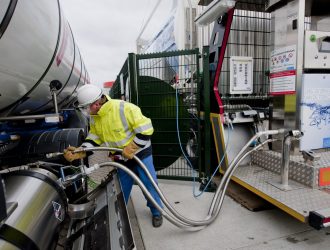
Even cleaner, even quieter. Here we are talking about the new generation milk trucks of FrieslandCampina. These milk trucks reduce the emission of CO2 by 20 to 24 percent. This is two times the reduction in comparison with 2014. What other sustainable steps are we taking in collecting the milk at dairy farms day and night? We talk about this with Jacob van der Meer, Manager Milk Logistics at FrieslandCampina.
“The less diesel we use when collecting the milk at the farm and bringing it to the plant, the less CO2 emission. In order to achieve this, we have set up four goals for the Milk Logistics department. The first goal is to drive fewer kilometres, so take along as much as possible milk in each round. Secondly, pump faster and electrically at the farms of the members (quieter, less fuel and so less CO2). Thirdly, further train the drivers and, finally, we are busy examining any options for cleaner fuels, such as (bio-)LNG, electricity and hydrogen.”
New generation
“We have taken some great steps with respect to this. I would like to zoom in on the last-mentioned goal: cleaner fuel. We started using LNG, an alternative fuel for diesel, in 2014. At that time, six of our milk trucks used diesel with added LNG. With this we achieved a CO2 reduction of 12 percent for each truck. Cleaner road transport is perfectly in line with our ambition to be leading in sustainability. Therefore we keep stimulating external carriers to work in a more sustainable way. Many of our carriers have reacted positively to this, with the result that a milk truck may achieve 20 to 24 percent CO2 reduction by the end of the year 2020. Twenty of these new generation milk trucks will use this cleaner fuel by the end of this year.”
Cleaner road transport is perfectly in line with our ambition to be leading in sustainability.
Limited availability
“If it were up to me, all milk trucks will soon drive cleaner. I am realistic, though: it must be possible to arrange things in an operationally feasible way. As long as diesel is available at every corner of the street and LNG is almost nowhere to be obtained, we as FrieslandCampina may want to do things a lot cleaner and faster, but we will not succeed in this right away. Presently, LNG is available at only twenty filling stations in the Netherlands. Therefore we are fully committed to recommending LNG trucks to our carriers. In fact, the more trucks start driving on LNG, the more LNG filling stations there will be in the near future. The same holds for hydrogen, which is available at only five places in the Netherlands. We are also working on bio-LNG, produced from manure, among other things. Due to the relatively complex technology, this is still produced on a small scale. At this moment, developments are taking place in small-scale liquefaction plants, which brings the production and the use of bio-LNG another step closer.”
Generation of energy thanks to braking energy
“Our stimulation of carriers recently also resulted in an innovative development: a milk truck with solar panels and braking energy on the axis of the trailer. The latter is really something new in milk transport and nowhere to be seen yet. When the milk truck brakes, a generator on the axis of the trailer is driven and this will generate energy. This energy is used for pumping the milk at the members' farms. This means that the dairy farmer does not have to supply energy any longer. The objective of this is to directly use the energy and, on top of that, we can measure how much energy we generate and consume while pumping. In this way we can collect more and more data. This data we can use to further innovate in sustainable transport.”
