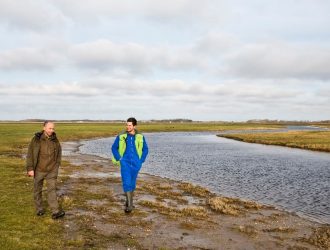
Populations of animal species are rapidly declining and natural habitats for meadow birds are disappearing on a large scale. The dry soil makes food scarce, there are hardly any insects for young birds due to the absence of flowers and because of the early mowing, the grasslands offer little shelter against predators. Member dairy farmer Gerco Eelman and forester Loran Tinga of Natuurmonumenten (the largest private organisation for nature conservation in the Netherlands) are working together with 24 other Texel farmers on improving the natural habitats for meadow birds. By bringing the biodiversity up to the required standard, meadow birds will feel at home again in their grasslands.
Bird paradise on the island of Texel
“We have been busy protecting nature on Texel for over a hundred years already”, says Loran. “Just in view of the breeding birds, a plot in the Waalenburg polder, in the centre of the island, was bought on a proposal of Jac. P. Thijsse in 1909.” The co-founder of Natuurmonumenten lived on the island for a few years and he made a Verkade-album about Texel in 1927. In his famous lyrical style, he wrote: “But birds! Good heavens, how many birds there were. They walked in the creeks, stood snoozing on the banks, sat in the grass and flew hither and thither. There was the yodelling of redshanks, the screaming of oystercatchers and the calling of avocets, the twittering of larks and pipits and even already the screeching of common terns. […] Only those who have seen the north in those years can believe how wonderful and plentiful bird life can be even with us in the Netherlands.”
Working together
Waalenburg still is a core area for meadow birds, as Drijvers Vogelweid De Bol and Dijkmanshuizen are. The society now manages a total of about thousand hectares of grassland, in which meadow birds are breeding and rare orchids, such as the green-winged orchid, are flowering. Foresters and farmers make arrangements about how they can bring these grasslands in tip-top condition again for meadow birds.
One of the participants is FrieslandCampina's member dairy farmer Gerco Eelman from Oosterend. He, his brother Robin and his parents Jaap and Astrid have a farm with 140 dairy cows and 50 breeding sheep. 60 hectares of their area is primarily used for producing feed for the cows and fits in with the aim at sustainable circular agriculture. On 40 hectares full priority is given to nature. The young farmer rents 30 hectares of those 40 hectares from Natuurmonumenten. “I want to treat my cows well. This does not only involve the production of milk, I also want them to comfortably grow old on our farm”, according to Gerco.
The cooperation is getting better all the time
Better soil life thanks to solid farmyard manure
The farmers only spread solid farmyard manure to improve soil life. In order to get a lot of variation in plots of high grass, less high grass and low grass, they make a schedule of when and where to mow.
When mowing - which never happens earlier than 1 July – this is always done from the inside to the outside, giving the young meadow birds that are still there the chance to escape to the edges. Also strips are left on which various grass species and other plants are growing. Here not only birds can find food in the winter season. Thanks to these strips, mice can survive the frugal months as well. When there are enough mice, the marsh harrier will less often hunt for young meadow birds.
Substantial improvements are also expected with respect to another basic condition. Just like the main part of the farmland, the Waalenburg polder had run dry. Since a few years, there are no farms left, as these have been moved to other parts of the island. Everything in the polder is now focused on the recovery of nature. The groundwater level can rise again. This will happen very gradually by about 10 to 20 centimetres a year. Here it is carefully observed if this does not cause any damage to the surrounding farms. According to Natuurmonumenten, the cooperation between the foresters and farmers on Texel shows how the farmland can be brought to life again.
We used to be tenants, but now we are partners
“We also attend trainings together”, Loran tells us. “A fine way to gain insight into each other’s work. Farmers learn to understand why we want to take certain measures and I learn how they run their businesses.” “We used to be tenants who had to meet various conditions. Now we are partners”, Gerco states.

Confidence
A nature-friendly farm is a home to many plants and animals. Water, flowers, insects, peace and quiet. All these elements will restore the home for meadow birds in the coming years. Farmers and foresters have confidence in this. “The cooperation is getting better all the time”, Gerco says. “And my interest is growing as I gain more insight into which measures have positive effects on nature. Therefore, I want to manage more nature in the future. If supermarkets and consumers pay fair prices, a lot more farmers can make a shift towards nature-friendly agriculture.” “We are on the right track", Loran adds. “We make proper arrangements and everyone sticks to them. With the large, open polder in which the water level is rising, the breeding results will really improve in the next few years. This will make the moment that the first black-tailed godwits will be back again even better, although the times of Thijsse will never return.”