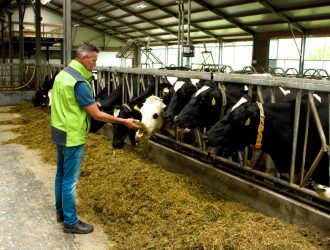
Dairy produced in good balance with nature and climate: FrieslandCampina strives for climate-neutral dairy in the year 2050. Barry Callebaut, the world’s largest chocolate manufacturer and a customer of FrieslandCampina, has the same ambitions and also applies a chain-wide approach with respect to this. The two companies joined forces and started a chain-wide cooperation to reduce the greenhouse gas emissions at the farms by means of an additive in the cattle feed.
“Sustainability increasingly becomes a prerequisite for being able to market our dairy products. As we are taking the lead in sustainability, we are an attractive partner to cooperate with. With this we distinguish ourselves in the market and it helps us to maximally valorise the milk supplied by our member dairy farmers”, according to Barbara van Hoorn, Key Account Manager at FrieslandCampina.
Leading
This is also endorsed by Oliver von Hagen, Director Sustainability Ingredients at Barry Callebaut. "FrieslandCampina is leading in the area of sustainability. We were looking for a partner that will enable us to test new initiatives with respect to sustainability and that shows leadership. Because of this, we have really consciously chosen for FrieslandCampina”, Oliver explains. Barry Callebaut purchases, among others, milk fat from FrieslandCampina for the production of chocolate. The multinational wants to reduce its carbon footprint in the entire supply chain and, consequently, that of dairy ingredients as well.
FrieslandCampina as a partner is a very conscious choice
Pilot from grass to ‘glass’
The member dairy farmers of FrieslandCampina, feed additives producer Agolin and feed supplier Agrifirm together started a pilot to explore new ways of reducing greenhouse gas emissions in 2020. Over forty member dairy farmers tested the feed additive of Agolin, which Agrifirm supplied in a mineral mixture to dairy farmers, for a year.
Over eight percent reduction
The additive, which is a mixture of plant extracts from spices and herbs, has been on the market for some time already. Its effect on, among others, the methane reduction was studied scientifically before. According to Gold Standard the additive has the potential to reduce methane emissions from the cow’s rumen by over 8 percent. The use of this may also lead to improved milk production and fertility.
“My feed advisor asked me to participate in this project. I think this is a nice example of how a question from the market can be passed on to the farm. In my opinion, this is a nice opportunity for our cooperative and I really want to contribute to this. The project includes the entire chain, from glass to grass. We all have fulfilled a role”, Gerhard de Visser, dairy farmer of FrieslandCampina, tells us.
Experiences of participating farmers
“Within this cooperation different parties were brought together and this made it possible to directly interact with the dairy farmers of FrieslandCampina”, Oliver continues. “This direct link with the dairy farmers was crucial to us. It was not that we wanted a confirmation of the impact of the additive on the emission of greenhouse gases, but we wanted to study in practice how the dairy farmers experienced the use of it at their farms and what according to them were the advantages and disadvantages of working with a feed additive such as Agolin.”
Direct link with dairy farmers is crucial
These user experiences were generally positive. Dairy farmers who gave the additive to their cows monitored the effects of this at their farms. During the workshop they told us what effects they saw and if these were convincing enough to keep giving their cows this additive. Although not everyone came to the same conclusion, the majority of the participating dairy farmers thinks about continuing to give their cows the additive. An important signal that was given was the valorisation of the methane reduction. For this, it is desirable that the efforts on the farm are directly rewarded.
On to a carbon neutral future
The practical study has provided more insight into the considerations of dairy farmers with respect to the use of additives such as Agolin and the problems they experience in connection with this. The study has also shown us how feed additives can help us reduce the greenhouse gas emissions. The results take FrieslandCampina further on its journey towards a carbon neutral future. “We do this both for a better planet and because the customers and the consumers are asking for it”, Barbara concludes.