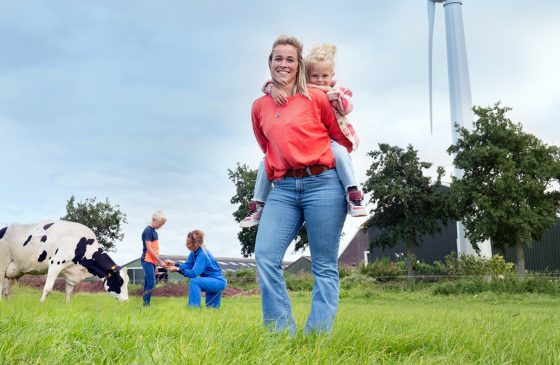
‘Our children play and learn a lot on the farm,’ says Patty. Her children often play on the farm with their classmates, the children of farmers Janneke and Jelmer. ‘They absolutely love that. Meanwhile, they playfully discover how farmers take care of their animals and the landscape.’
Cows in white sheets!
Patty: ‘I think it's important that children spend a lot of time in nature and get to know farm life. That's why I think it's so good that Janneke and Jelmer give guided tours to school classes. What do the children notice first? The cloth cows, a special breed of cow. ‘Mum, those cows have white sheets on them’ they say!’

Attention to the environment
On Janneke and Jelmer's dairy farm, you will find dairy cows, young cattle and special breed chickens. What is striking is how neat the farm, the yard and the surrounding land look. Farmer Jelmer: ‘We like everything to be tightly organised, with a good meadow for the cows, and we combine that with attention to the environment. We are also landscape caretakers and do our utmost for our farm as well as for the landscape.’
We like to tell our story
Jelmer: ‘As farmers, we want to become more sustainable step by step and create support for this. That way, we do beautiful things here for our farm, our animals and the landscape. And we like to tell our story about that, to young and old alike.’
Full of flowers and herbs
Bees and butterflies also like to visit the farm. Logical, as it is a star restaurant for them: between the meadows are strips full of tasty flowers and herbs. Janneke: ‘They complete the overall picture. The nectar in the flowers is food for butterflies, bees and other insects. And that in turn attracts all kinds of birds. This is how we lend nature a hand.’
Schools discover farm life
‘We regularly host school classes who come to discover farm life,’ Janneke continues. ‘Children quickly understand how things work at a farm and how we work with nature and the landscape.’ Jelmer: ‘Usually half the children go with me and I show them the cows. And Janneke takes the others to look at the flowers, vegetables and all kinds of things in the yard. Amazing how surprised the children always are how things go around here!’
Know what you eat
Next to the yard it looks colourful. Janneke: ‘Beautiful isn't it? We have created a vegetable garden, a small flower garden and a dahlia garden here. We also like to take the school classes there. This way, they become aware of where their food comes from and how nature grows and blooms.
What special cows!
Jelmer: ‘In the places where our cows don't come easily, the less used corners of the land, we have Dutch Belted cows. This is a special breed of cow and they add a bit of beauty to our landscape. Children respond enthusiastically to these beautiful animals’. Janneke: ‘We also have special breeds of chickens to show the difference in eggs. Not every egg is the same, you have all kinds and flavours.’
Natural cycle
Jelmer: ‘Through the municipality, we get green waste from which we make compost. We spread it as fertiliser on the land. That way you help create a closed cycle, because you don't have to throw away the green waste. We think it is important to give something back to the earth, because as humans we also use a lot of the earth. That's how we contribute to the natural cycle.’
We generate our own electricity
‘Boys, it's time to go home!’ Patty comes to pick up the children, but they are nowhere to be found. ‘I think they are at the windmill,’ says Janneke. Jelmer: ‘Children are often impressed by how high the windmill actually is, especially when they are standing near it. We then explain to them that we use it to generate our own electricity, so that our farm is as self-sufficient as possible.’
