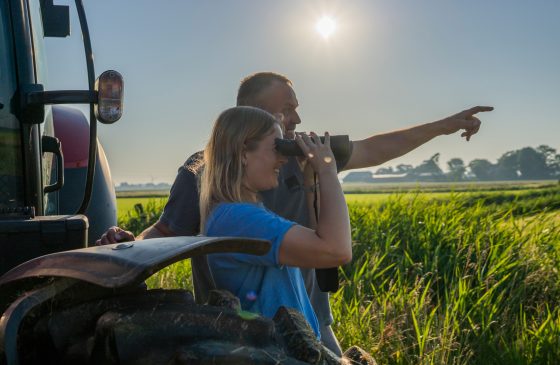
At the crack of dawn, when the sun has just risen, a drone hovers high above the pastures of dairy farmer Bert in Achlum, Friesland. Using a thermal camera, the drone searches for the well-hidden hiding places of fawn in the grass. “If we find such a fawn, we mark the spot with sticks. Then when we come with the mowers you can see where the fawn are and we make sure we stay away.”
Lending nature a hand
“Great that this is possible like this right?” says Jantine, a fellow village member of Farmer Bert. She knows Bert from the village hall board and she will join him this morning to look for fawn. “I really appreciate that Bert respects nature in this way,” says Jantine. Bert: “The love for nature is ingrained in us, because as a farmer you are also a nature caretaker. Not only do we take good care of our 120 cows, but we also do agricultural nature management. For example, we manage 20 hectares of nature land that we leave alone and do not mow between April 1 and June 15. During that time, the roe deer also raise their young and meadow birds brood on their eggs.”

Wildlife manager works with drone pilot
Before mowing, we first check whether there are any fawn lying around. Jantine: “In the high grass they feel safe from predators, such as foxes. With their dotted backs they are well camouflaged.” Bert: “A fawn stays in place and instinctively stays very quiet. The mother then occasionally comes to nurse.” Together with a drone pilot, the wildlife manager scans the area. Attached to the drone is a thermal camera that detects the body heat of animals. Bert: “That's why we search early in the morning, when it's still cool. Then the thermal camera can find the warm spots the best. It's not always a deer though, it can also be a hare or another animal.”
When the drone pilot sees a fawn on his screen he tells the wildlife manager where it is and he marks the spot with sticks. Bert: “Immediately after that I mow and through the sticks I can tell where the fawn is. Then I mow well around its hiding place, leaving a patch of tall grass. We feed the cut grass to our young stock and when the fawn is big enough to go on an adventure, we let the young stock graze on this spot.” For Bert this approach, which connects technology and environment, is more than just part of his job: “It is also our passion and responsibility as farmers and nature caretakers. With agricultural nature management, we can actively contribute to biodiversity on the land, such as maintaining rest periods for the animals and birds in the area.”
Shelter for meadow birds
Jantine: “It is a wonderful sight when you see those young fawn frolicking through the field with their mothers.” “Yes beautiful isn't it” agrees Bert: “It gives great satisfaction when you can take care of these beautiful animals in an innovative way. The connection of your work as a farmer and the natural environment really gives you a kick.” Bert: “Our meadows are also a safe haven for meadow birds such as oystercatchers, black-tailed godwits, redshanks and lapwings. We also give them the chance to raise their young in peace and quiet. But look, see that roe deer over there in the distance?”
