FrieslandCampina is working towards sustainable dairy farming with a focus on animal health and welfare, climate, soil, water and nature. Regenerative agriculture is one of the promising routes to a future-proof form of business for member dairy farmers. Customers also see opportunities and are willing to invest in regenerative agriculture. ‘This is why, with the Regenerative Agriculture Pilot, we are committed to accelerating the development of this form of agriculture,’ said Guus van Laarhoven, sustainability manager at FrieslandCampina.
Regenerative agriculture in dairy farming aims for a natural balance between the production factors of cow and soil. It combines sometimes ancient knowledge with modern means and techniques. The farming practices contribute to healthy soil, clean water and diverse nature. This strengthens the balance between the carrying capacity of the earth and food production.
Practical experience
The pilot brings together a diverse group of 20 FrieslandCampina member dairy farmers from the Netherlands, Belgium and Germany in a study group. Based on practical experience, they will develop knowledge, experience and insight about the effects of regenerative farming practices over the next few years. This will also focus on practical and financial feasibility of measures.
In practice, the route to regenerative agriculture looks different for each farm. The farmer diversity in the study group is therefore essential to gather different insights. What the dairy farmers have in common is the motivation to explore together what it means to farm ‘regeneratively’ and what the impact is on the farm.
Four showcase farms as inspiration
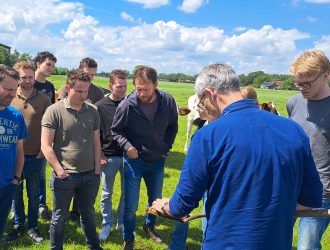
The kick-off of the study group took place last 28 May at FrieslandCampina dairy farmer Robert Nijkamp's farm in Raalte. Nijkamp's farm is one of four demo farms within the pilot. These farms are already actively integrating climate and nature measures and are achieving demonstrably good results. They represent different business philosophies: organic, nature-inclusive, circular and efficiency. In doing so, they serve as practical examples and sources of inspiration within the study group.

Measurable, tangible and reliable
Of the nearly 10,000 dairy farms that are members of the cooperative, FrieslandCampina has been measuring, monitoring and rewarding results on animal health and welfare, climate and biodiversity since 2018. ‘Together, we are taking steps year on year to become ever more sustainable. We want to work within planetary boundaries because the future of our farmers depends on this. We therefore set the bar high for what we call regenerative agriculture. It is essential that results for climate, soil, water and biodiversity are measurable, tangible and reliable,’ says Guus.
Three phases towards regenerative
The dairy farmers in the study group are working towards a farm focused on regenerative farming in three phases:
- A baseline measurement - the RegAg Ready score - is used to determine the extent to which the dairy farm already operates within the ecological carrying capacity of the planet. A business development plan is then drawn up, setting out the future plans for the farm, the actions they will take and how these will be monitored.
- Based on these insights, dairy farmers then start with the first measures on the farm to gain practical experience and see what the effect is.
- They will then expand the regenerative management that suits their farms through measures that require investment. These investments are necessary for most businesses to really move towards regenerative results across all aspects of their business.
Guus: ‘This last step requires a big choice from a farmer with a long-term impact for their farm. As FrieslandCampina, we don't want that burden to rest on the shoulders of our farmers. That's why we are working with all kinds of parties, such as in the ReGeNL consortium, to spread the risks and costs of this transition. To scale up regenerative farming practices with a larger group of dairy farmers, it is important that we can link the demonstrable impact to developments in the market, so that we can ensure better incomes for the farmer. Together, we can then really get the flywheel going. With our approach, we want to show that regenerative agriculture is really possible in practice, realising benefits for the farmer, the climate and nature.’