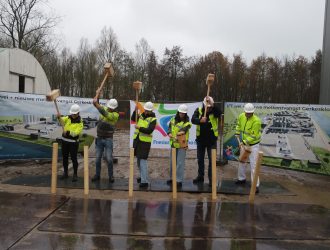
FrieslandCampina starts with expansion of Gerkesklooster and Workum plants. The first piles were driven into the ground at the Gerkesklooster and Workum plants on November 27 and December 5, 2024. These events mark the start of expansions aimed at supporting FrieslandCampina's whey valorisation goals and sustainability efforts.
Whey is the liquid by-product left over after curdling milk in cheese production. Whey contains high-quality proteins that are concentrated and processed into products such as Whey Protein Concentrate (WPC)). These ingredients are widely used in sports nutrition, dietary products and medical nutrition because of their nutritional value and rapid absorption by the body.
Workum: higher capacity and more sustainable
After 2.5 years of preparation, the expansion of the whey production site in Workum has officially started. This €30 million investment will make it possible to process all whey from the cheese factory in Workum into high-quality WPC products from the last quarter of 2026. An important part of the expansion is the replacement of a 50-year-old gas-fired evaporation plant with a more environmentally friendly alternative. This new plant will provide annual savings of 6,800 tonnes of CO2 and 350,000 m³ of drinking water, equivalent to the annual water consumption of 22,000 households.
Bob Schultze, project manager at FrieslandCampina, explains: "Offsetting 6,800 tonnes of CO2 would require 340,000 trees. This step is essential to achieve our ambition of net climate-neutral production by 2050."

Gerkesklooster: optimisation of processing and new milk reception
In Gerkesklooster, two major projects are being carried out in combination: the optimisation of whey processing for infant formula and the construction of a new milk reception facility. This involves a total investment of around €20 million.
Gooitzen Stellingwerf, project manager at FrieslandCampina: ‘After completion of this project by the end of 2025, more high-quality whey will be suitable for processing as an ingredient for the production of infant formula at our production facility in Borculo.’
The second project at the Gerkesklooster site involves replacing the outdated milk receiver, which requires a lot of maintenance. A major advantage of the new milk receiver is that more water can be reused, reducing the need for mains water. The new milk receiver is expected to be commissioned in mid-2026.