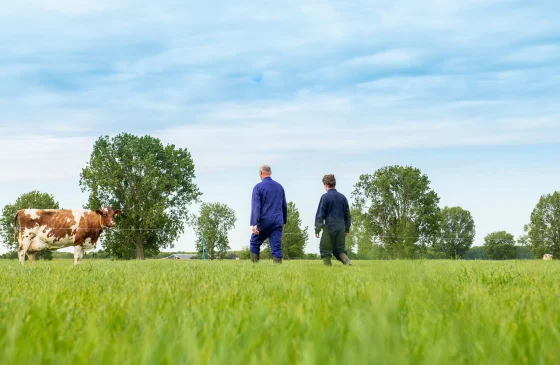
Three focus areas for sustainability on the farm
Our member dairy farmers focus on their carbon footprint, biodiversity and animal welfare. After all, in order to have a sustainable dairy farm, animals and ecosystems must be healthy and emissions must be minimal.

Carbon footprint
Our cooperative and member dairy farmers collaborate and work hard to reduce their carbon footprint.Biodiversity
The greater the biodiversity, the greater nature's resilience and ability to recover. And nature is the driving force behind every dairy farm.Animal welfare
Healthy cows live longer, need less medication and produce more – and more sustainable – milk.
Sustainable business operations
Sustainable business operations are the core of our member dairy farmers’ work. Caring for animals and nature is part of our DNA. With their practical knowledge as a guide, the individual member dairy farmers see what suits them and their business operations in terms of sustainability.
Future-proof
Our definition of sustainable business operations goes beyond caring for animals and nature. It also means that our member dairy farmers build a business that is future-proof. A business in which they continue to produce nutritious food and with which they can tackle challenges, both now and in the future. Sustainability is important for achieving Our Purpose, Our Plan.
FrieslandCampina supports the member dairy farmers
Although our member dairy farmers are eager to work more sustainably, they do not always have the funds for this. That is why we are happy to lend a hand. We support and encourage them in our Foqus planet sustainable development programme. This is a quality and sustainability programme in which we ensure a minimum level of quality and sustainability and encourage member dairy farmers to improve on sustainable farming by receiving a bonus based on the results of their efforts in the areas of climate, biodiversity and animal health and animal welfare.
Manure mono-fermentation
Apart from conservation of the environment and continuous improvement of animal welfare, FrieslandCampina also aims at climate-neutral growth. Generation of sustainable energy makes a considerable contribution to reducing the greenhouse gas emissions. Besides wind and solar energy, the production of biogas by means of manure mono-fermentation at farms is another way to generate sustainable energy. Manure mono-fermentation is the fermentation of liquid manure only, in contrast to co-fermentation where animal manure is mixed with other products before intake at the fermenter takes place.

Cooperative Jumpstart
FrieslandCampina is the founder of the Jumpstart cooperative. We use the Jumpstart cooperative to help member dairy farmers convert manure into green energy in a profitable way. It helps them get financing, permits and subsidies for a mono-manure fermenter on their dairy farms. We have also developed a mineral separator which fits with circular agriculture by creating a tailor made soil fertilizer. For this, Jumpstart makes collective agreements with suppliers (Biolectric, Biogas Plus, HoSt, Fabiton and Askove) and consumers and represents the interests of members towards governments and the sector. This makes it more attractive for member dairy farmers to structure their business even more sustainably. One example of what we do is convert methane into clean energy and reduce CO₂ emissions.
Curious about how our farmers care for nature?
We have dozens of examples of how our farmers provide good nature and landscape management, sustainable operations and the best care for their cows. Linda Groot Wassink, our global sustainability project manager, has created several vlogs on this topic.
Dairy Development
Thanks to all of their hard work, our member dairy farmers know a lot about sustainability. They share this knowledge with others through our Dairy Development activities. We use this programme to support farmers in Asia, Africa and Eastern Europe with our knowledge and expertise about sustainable and efficient business operations.
Last modified on: 01/02/2023 03:12