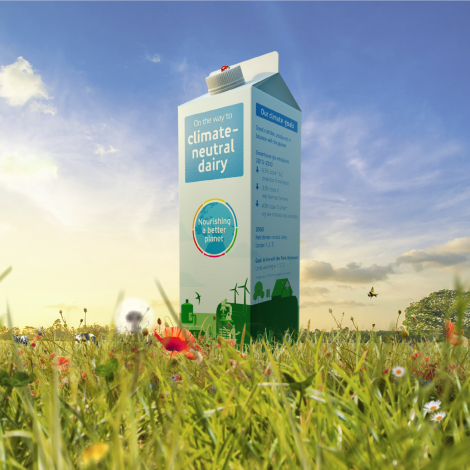
FrieslandCampina’s climate plan is part of its Nourishing a better planet sustainability programme, within the compass of which attention is also devoted to good and affordable food, a good living for farmers, biodiversity, sustainable packaging, and sustainable sourcing of raw materials. We aim to produce net climate-neutral dairy by no later than 2050. The climate plan contains clear targets and concrete actions, with a checkpoint being a significant reduction in greenhouse gas emissions by 2030.
Our aim: reduction in line with the ‘1.5°C’ pathway
By 2050, we want to achieve net climate-neutrality in terms of our scope 1, 2 and 3 emissions. This means that we will be reducing emissions as much as possible and compensating for what we cannot reduce. Science Based Targets initiative (SBTi) has confirmed that FrieslandCampina's 2030 climate targets (scope 1 & 2) are in line with the maximum 1.5 degrees Celsius warming agreed in the Paris Climate Agreement.

How do we contribute?
If we look at solutions to reduce greenhouse gas emissions in the cooperative we mainly see two elements: reduction in emissions and compensation or absorption of the emissions. And we look at energy use, (production of) feed, animals, manure and soil. There are many projects, a few are highlighted below.

Energy
We support the transition to green energy. Over 3,400 of our member farmers are currently also energy farmers. Through sun, wind and manure. Our Dutch brand Campina is fully powered by the green electricity of our farmers for instance. Did you for instance know that all our global production locations run on 100% green electricity and that 50% of that energy comes from the green energy our member farmers generate themselves?Animal
We look at cows emitting less greenhouse gases by themselves. They can be chosen for selective breeding, of course always taking the animal’s welfare into account.Feed
We support our member farmers that produce most of the feed for their cows on their own land or that locally source it. That’s what those meadows are for. Producing it themselves prevents unnecessary emissions. Sowing clovers for instance, can absorb extra carbon too. With our partners we have also tested and researched feed additives that can prevent or reduce methane emissions, like Agolin or Bovaer.Manure
We look at ways to reduce and reuse manure. Because manure is not only full of nutrients, it’s also full of energy. That’s why we’ve been testing with manure digesters for years so we can generate biogas and the residuals are high quality manure that can be used on the land.Soil
If we can continue to improve biodiversity and enable that plants and soil grow stronger and for instance work with permanent grasslands, hedges and tiny forests at the farm, that can take more carbon out of the air.- About the climate plan
Frequently asked questions
We are committed to our climate ambition and are working hard to achieve our goals. We broadened our scope, increased the greenhouse gas reduction targets and committed to the -1.5 degree Celsius global warming goal of the Paris Climate Agreement.
On the way to climate-neutral dairy
In the climate plan, we state FrieslandCampina’s vision on sustainability, our climate goals, our achievements in recent years, where we are today. And what our plans are, as well as what we are doing to realise them. It also provides insight into how we are calculating and accounting for our climate actions.

Last modified on: 25/01/2023 01:58